How AI Headshot
Generators Work
🧠 The Core Process
You upload 10-20 reference selfies for the AI to study.
The AI trains a mini-model (LoRA) specifically on your likeness.
The AI "denoises" a static image into a professional portrait.
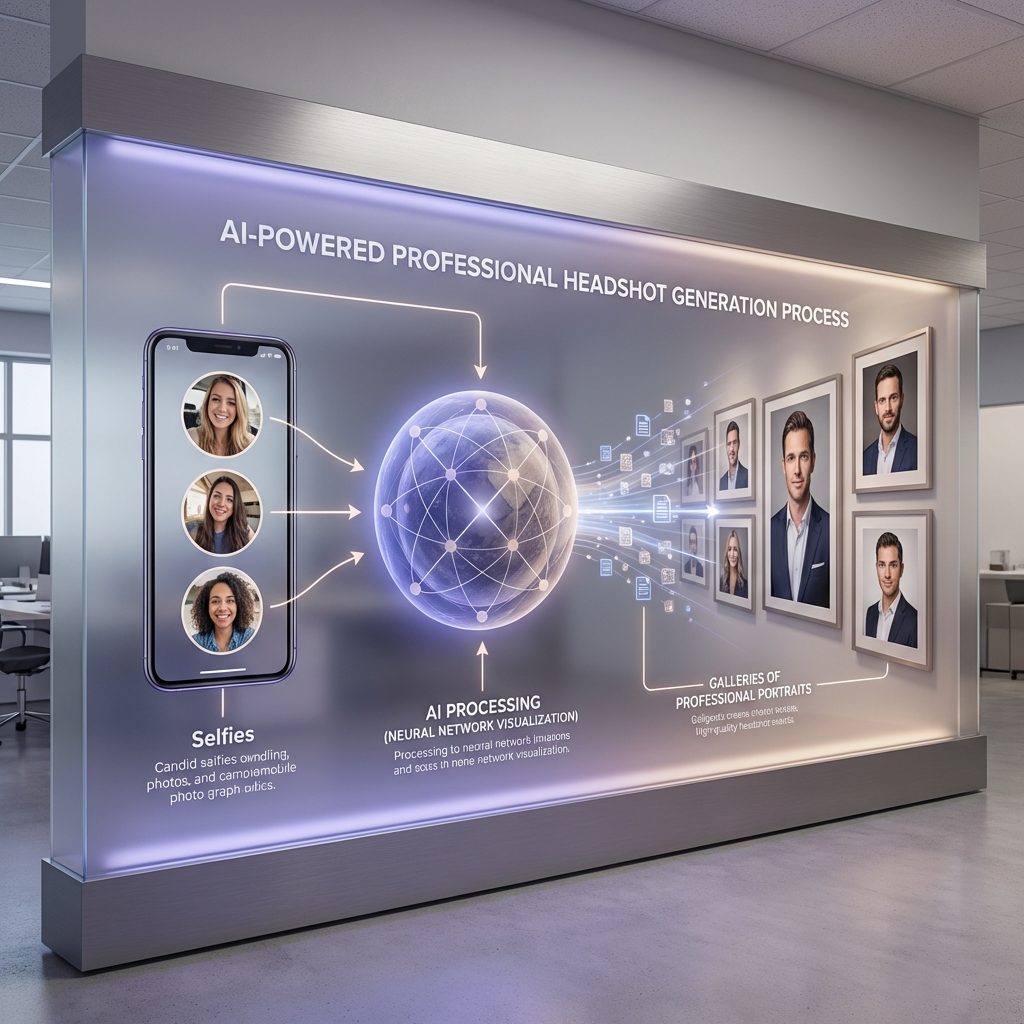
Visualization of the neural network processing selfies into a professional gallery.
Understanding Generative AI
AI headshot generators are not simple "face-swapping" tools or filters. They don't cut your face out of a photo and paste it onto stock photography. Instead, they use Generative AI to build a brand-new image from scratch, pixel by pixel, based on the patterns they've learned about your face.
The Misconception
Unlike Photoshop, which manipulates existing pixels, Generative AI creates new pixels that never existed before. This is why the AI can give you a suit you've never owned or a hairstyle you haven't worn in years.
Stage 1: The Library of Visuals
Before you ever upload a photo, the AI "brain" has already studied billions of images. This is the Foundational Model. It knows exactly what "professional lighting," "Italian wool blazer," and "bokeh background" look like. It contains the general rules of composition, light, and human anatomy.
Stage 2: Making It About You
When you upload your 10-20 selfies, the service performs Fine-Tuning. It essentially locks the AI artist in a room with your photos until it can "draw" you from memory with 100% accuracy.
Technically, this often uses a method called LoRA (Low-Rank Adaptation), which creates a tiny data file that modifies the foundational model to prioritize your unique features—nose shape, eye distance, and skin texture.
Stage 3: The Diffusion Step
This is where the image is actually "born." The AI starts with a field of random static (mathematical noise). Guided by a text prompt—like "Professional CEO in a minimalist studio, sharp focus, indigo lighting"—it begins to "denoise" the field.
It subtracts the static and replaces it with patterns that match the prompt and your personalized face model. After 20-50 iterations, a high-resolution portrait emerges from the chaos.
See the Tech in Action
Now that you know the science, it's time to choose the platform that uses the most advanced models for the most realistic results.